SmoothScar Inc. / Evidence & Education / BioRNA vs silicone sheets
BioRNA patch vs silicone scar sheets
If you are choosing between a BioRNA patch and a silicone sheet, you are choosing between two different ideas for the same scar. A silicone sheet or tape covers the scar and keeps it hydrated and protected. A BioRNA patch is a dissolving patch: tiny hyaluronic-acid tips melt into the skin overnight and deliver RNA where the scar is forming. This page puts them side by side: what they are, how to use them, what they cost, and what the evidence says.
This is a results comparison, not a price one. Silicone costs far less than BioRNA — because it should. One ingredient to trap moisture, a soft covering. BioRNA delivers hyaluronic acid and hydrolyzed RNA into the scar to lessen the appearance and size of an old scar and help your scar heal better after surgery. The case for BioRNA is the result and the mechanism, for the scar that is raised, uncomfortable, or not settling — not for the scar that only needs a simple cover.
Side by side
| BioRNA patch | Silicone sheets and tape | |
|---|---|---|
| What it is | Dissolving hyaluronic-acid micro-tip patch with hydrolyzed RNA — not silicone. The tiny tips melt into the skin overnight. Two routines: BioRNA Daily (Antiscar), nightly; BioRNA-C, twice a week for C-section scars. | A soft silicone sheet or tape that covers the scar and keeps it hydrated and protected. Nothing is delivered into the skin. |
| How you use it | Daily: one patch every night, 8 hours, 7 patches per box. BioRNA-C: twice a week, overnight 8–12 hours, 8 patches per box. Start only after the wound is fully closed. | Worn on the scar, usually overnight and up to 24 hours at a time, once the wound is fully closed. Most sheets and patches are reusable for days — wash, dry, and reapply; Frida Mom’s C-section patches last up to 7 days each. |
| How long one box or pack lasts | Daily: one box = 1 week. BioRNA-C: one box = 4 weeks. | One pack of reusable patches can cover up to 6 weeks. For example, 6 Frida Mom patches × up to 7 days each. |
| What it costs | Daily: $300 a box. 2 boxes $515 · 3 boxes $710 · 4 boxes $880. BioRNA-C: $375 a box. 2 boxes $600 · 3 boxes $825 · 4 boxes $1,000. | Far less — because they should be: one ingredient to trap moisture, a soft covering. For example, Frida Mom’s C-section patches are $22.99 a pack at Target (checked Nov 20, 2026; 4.3 stars from 260 ratings). One pack covers up to 6 weeks; a full 8 weeks takes a second pack — $45.98 in total. |
| What the evidence says | Small split-scar study, 3D-scanner measurements: scars down up to 95% (highest result, not an average) on the BioRNA side, and scar volume 30% lower than on the silicone-sheet side in the same study. 85% had no worsening 16.1 months after stopping. 88% reported better healing than with silicone gel sheets; 8 in 10 preferred BioRNA Antiscar over silicone gel sheets. | Silicone is the older standard. It works by keeping the scar hydrated and protected — it sits on the surface. The 30% figure in the BioRNA column is the head-to-head result from the BioRNA study — the same study, silicone on one side, BioRNA on the other. |
Scar volume, same study
Scar volume in the same split-scar study, with the silicone side set to 100. The BioRNA side was 30% lower. "Up to 95%" is the highest result, not the average. Individual results vary.
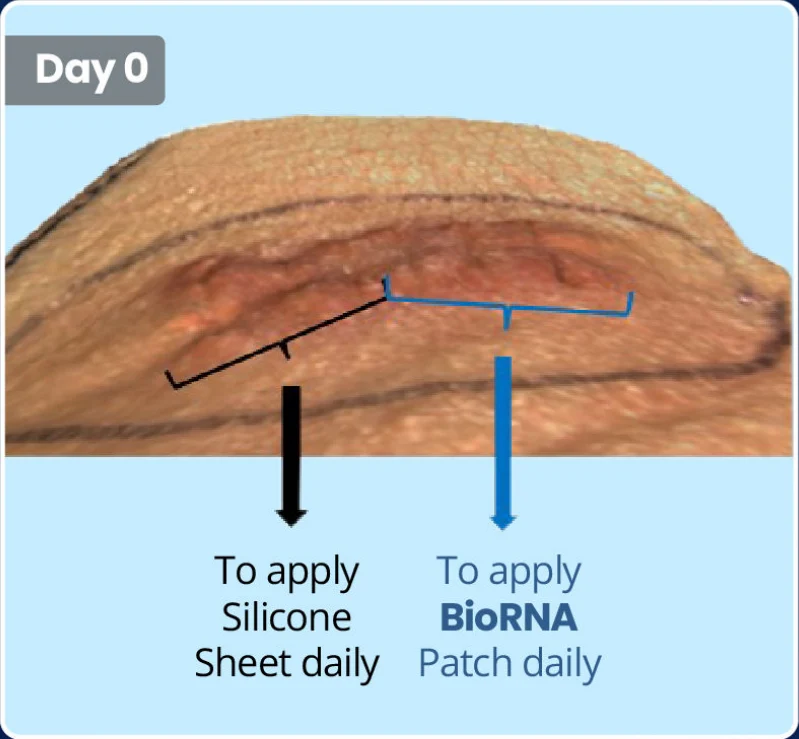
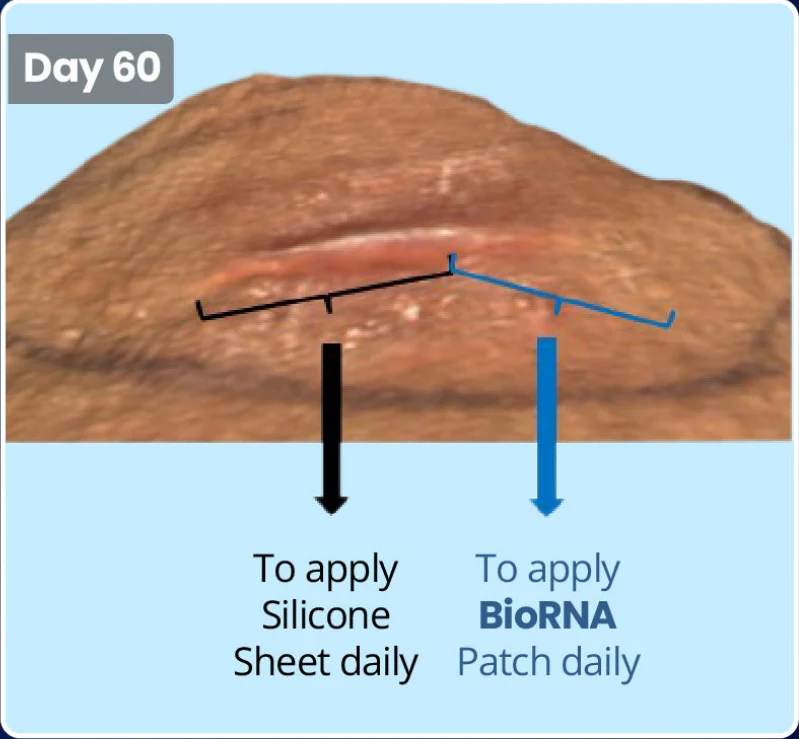
Clinical research example, Day 0 to Day 60: two sides of one scar received different treatments, as marked. The trial tested SPARC-targeting siRNA microneedles against silicone sheets. This is not a marketed BioRNA product result. Individual results vary.
Why silicone is the old standard
It is cheap, most sheets and patches are reusable for days, and waterproof options can be worn while bathing or swimming. For a scar that is settling well and only needs a simple cover, silicone is often enough. What it does not do is deliver anything into the skin — it sits on the surface. That is the gap BioRNA closes: dissolving micro-tips that melt into the skin overnight and deliver RNA where the scar is forming, and in the head-to-head study the BioRNA side came out 30% smaller.
Frida Mom’s silicone patch
Frida Mom makes a silicone C-section patch: 6 patches per pack, each 8 inches long, reusable for up to 7 days each, stored in the included Keep-Clean Case, waterproof. Frida Mom’s own listing says its patches “improve the look and feel of your scar by keeping it hydrated and protected” (fridababy.ca, checked Nov 21, 2026).
What the evidence says
These numbers come from a small manufacturer-reported study, not a large trial. A separate published trial in the British Journal of Dermatology (2024) tested a specific siRNA microneedle patch against silicone sheets and found 83.8% vs 74.1% scar-volume reduction. That trial used a different formulation, so its results are not BioRNA product results. There is no published double-blind trial of BioRNA yet; one is in progress. See the full evidence, with sources and limits.
Who each one fits
- Silicone sheets and tape are for the scar that is settling well and only needs a simple, low-cost cover that hydrates and protects it.
- BioRNA is for the scar that is raised, uncomfortable, or not settling — and for the person who wants the RNA approach and accepts the price.
If your scar is raised, painful, growing, or infected, see a dermatologist before choosing either one.
Questions about BioRNA and silicone
Is BioRNA a silicone patch?
No. BioRNA is a dissolving patch made of hyaluronic-acid micro-tips with hydrolyzed RNA. The tiny tips melt into the skin overnight. A silicone sheet or tape covers the scar and keeps it hydrated, and no ingredient is delivered into the skin.
What did the BioRNA study actually compare?
The split-scar study compared the BioRNA patch directly against silicone sheets: one side of the scar got BioRNA, the other got a silicone sheet. Scar volume was 30% lower on the BioRNA side, and the highest result was a 95% reduction.
How much does each cost?
BioRNA Daily (Antiscar) is $300 a box; 2 boxes $515, 3 boxes $710, 4 boxes $880. BioRNA-C is $375 a box; 2 boxes $600, 3 boxes $825, 4 boxes $1,000. Silicone sheets cost far less: for example, Frida Mom’s C-section patches are $22.99 a pack at Target, and one pack covers up to 6 weeks.
Which one should I pick for my scar?
It depends on the scar and the budget. Silicone is a simple, low-cost cover. BioRNA is for the scar that is raised, uncomfortable, or not settling, and for the person who wants the RNA approach and accepts the price. If your scar is raised, painful, growing, or infected, see a dermatologist before choosing either one.
Can I use either one on a fresh scar?
Only after the wound is fully closed. Do not use a BioRNA patch or a silicone sheet on an open or infected wound. If you are unsure when to start, ask your care team.
Where does the 95% number come from?
From a small manufacturer-reported study, measured with a 3D scanner: scars treated with the BioRNA patch were down by up to 95% in volume. Up to is the highest result, not the average. In the same study, 85% saw no worsening 16.1 months after stopping. Individual results vary.
Ready for your next step?
For a daily overnight routine, see BioRNA Daily (Antiscar). For C-section scars, twice a week, see BioRNA-C. Real day-by-day photos are on the Results page, and the full evidence is on the science page. Want the background first? Read how to remove a scar.
Start only after the wound is fully closed. Do not use on open or infected wounds.